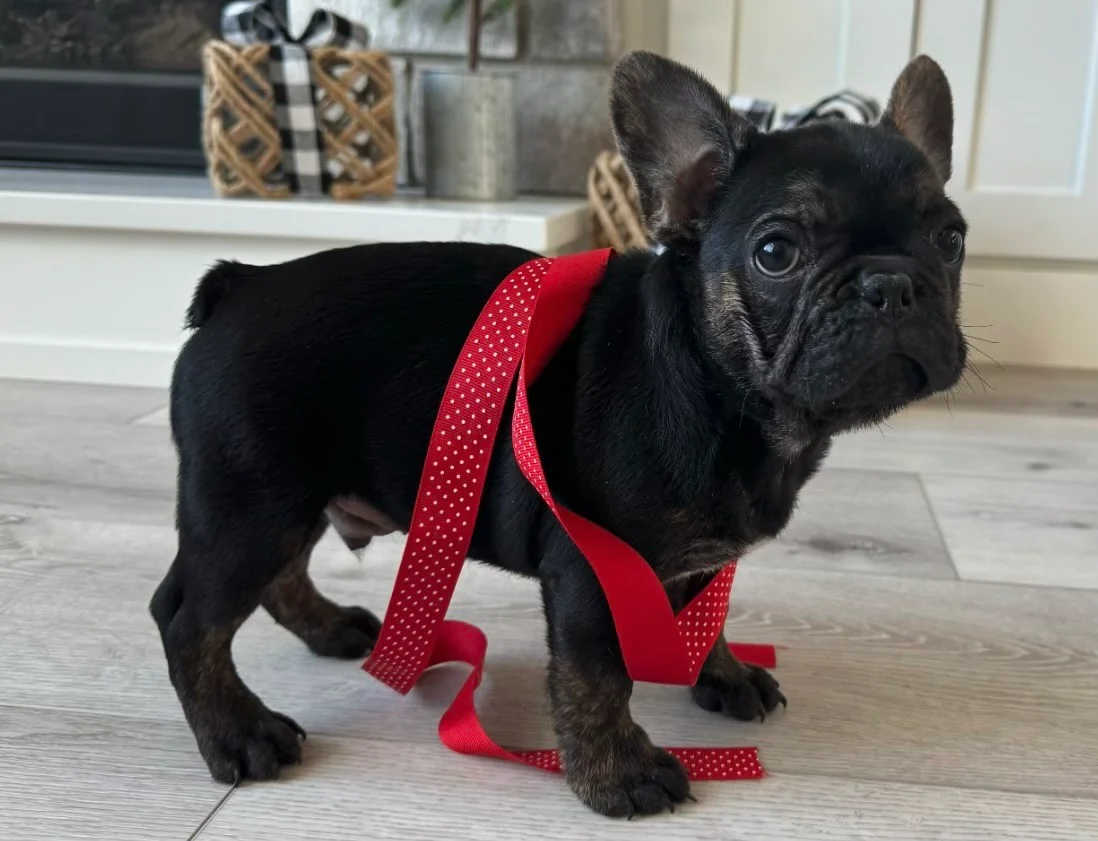

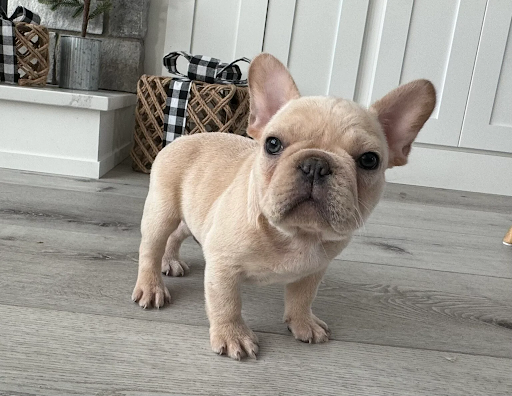
French Bulldogs are born with naturally short tails that are typically straight or screwed. While tail shape is a normal breed trait, it can also be relevant when considering a Frenchie's overall spinal health.
In this article, we explain the different French Bulldog tail types, what they mean, and what prospective owners should know when choosing a puppy.
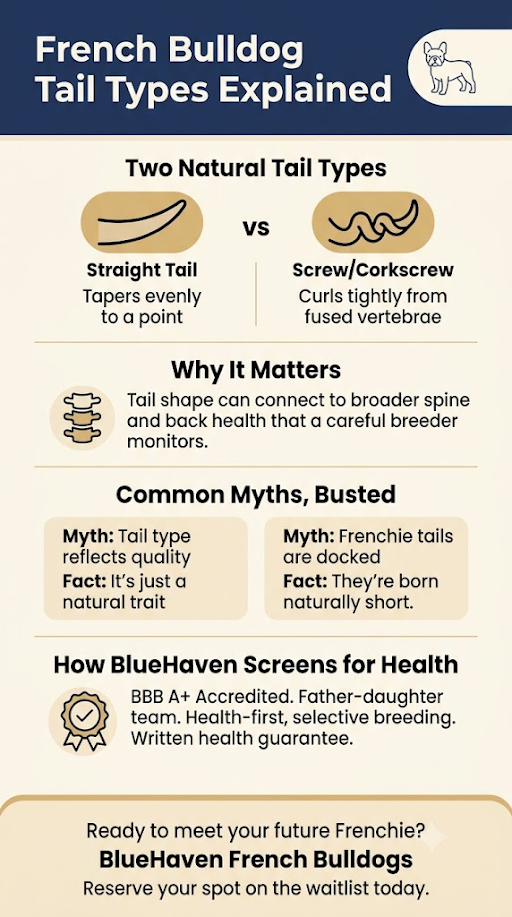
French Bulldogs have two recognized natural tail types: a straight tail, which tapers evenly to a point, and a screw tail, which curls tightly near the base from naturally fused vertebrae. The French Bull Dog Club of America's breed standard confirms both are acceptable, while a curled or curly tail is not.
A reputable breeder never docks a Frenchie's tail; every puppy keeps the tail it was born with for life.
A straight tail runs in a smooth line from the base to the tip, with a thicker root and a finer point. A screwtail forms when several tail vertebrae fuse together at an angle, creating a tight spiral instead of a straight line. Both patterns occur naturally within the breed, and both meet the accepted standard.
A puppy's tail shape sets before birth and does not change as the puppy grows. Breeders do not shape, trim, or dock a Frenchie's tail to create either type. A puppy born with a screw tail keeps that curl for its whole life, and a puppy born with a straight tail keeps that shape too.
Tail type on its own does not predict a dog's temperament or overall quality, but it can point toward broader spine and back health that a careful breeder already monitors.
A screw tail forms from fused tail vertebrae, and that same tendency toward vertebral fusion can extend further up the spine in some brachycephalic dogs.
A peer-reviewed study published in Veterinary Radiology & Ultrasound found that tail malformation severity was significantly associated with the presence of hemivertebrae, a related spinal vertebra condition, in French Bulldogs, English Bulldogs, and Pugs.
This is exactly why a reputable breeder looks at overall spinal health, not just the tail itself.
A screwtail often sits closer to the body and can trap moisture in the surrounding skin fold. Owners of screw-tailed Frenchies typically clean that area a few times a week to prevent irritation. A straight tail usually needs less specific care but still benefits from a normal grooming routine.
Two myths come up often when buyers start researching this topic, and both deserve a clear correction.
Some buyers assume a straight tail signals a "better" or more desirable Frenchie than a screwtail. Tail type is simply a natural anatomical trait, the same way a Frenchie's color is a matter of personal preference. Tail type does not determine temperament, conformation, or overall quality.
Many people assume the short tail comes from docking, since other breeds are docked for appearance. French Bulldogs carry naturally short tails from birth. Docking does not apply to the breed, and a reputable breeder never performs it.
Tail shape is only one small piece of a much bigger health picture, and a reputable breeder treats it that way.
BlueHaven French Bulldogs holds BBB Accreditation with an A+ rating, a distinction that reflects the same standard applied across the whole breeding program.
As the father-daughter team leading BlueHaven's multi-generational family operation, Bick and Lacey apply selective, health-first breeding that screens against joint and back issues rather than breeding for appearance alone.
Every puppy placement also comes with a written health guarantee, described as one of the strongest available, so buyers have real recourse if a concern arises.
Most Utah-based French Bulldog breeder websites focus on litter announcements and pricing, with little explanation of anatomical traits like tail type or what they mean for long-term health.
BlueHaven French Bulldogs fills that gap by walking buyers through the full picture before they reserve a spot, not after.
1. Are French Bulldogs born with tails?
Yes. French Bulldogs carry naturally short tails from birth, either straight or screw-shaped. A reputable breeder never docks a BlueHaven French Bulldogs puppy's tail.
2. What is a screwtail in a French Bulldog?
A screwtail forms when several tail vertebrae fuse together at an angle, creating a tight spiral shape near the base. This shape is one of two tail types the official French Bulldog breed standard accepts, alongside the straight tail.
3. Does tail type affect a French Bulldog's price?
No. Pricing for a BlueHaven French Bulldogs puppy depends on color and rarity, not tail type. Tail shape is a natural trait and does not factor into the pricing structure shared in the emailed information letter.
4. Can a French Bulldog's tail cause health problems later in life?
A screwtail itself rarely causes problems beyond the need for regular skin-fold cleaning. The broader concern is back and spine health in general, which is why a reputable breeder screens for joint and back issues across the whole breeding program, not just the tail.
French Bulldog tail types are one small detail in a much larger health picture, and now you know how to read them instead of guessing. BlueHaven French Bulldogs backs every placement with a strong written health guarantee and a father-daughter, multi-generational family team that screens for health first. Contact Bick at 435-770-5708 or email bluehavenfrenchbulldogs@gmail.com to reserve your spot on the waitlist and get the puppy of your dreams soon.
_1790025093.png)
Why Are French Bulldogs So Expensive and What It Means for Prospective Owners
Read More »
What Are French Bulldog Tail Types, and Why Do They Matter for Prospective Owners French Bulldogs are born with naturally short...
Read More »
What Is Involved in Buying an Adult French Bulldog and Why It Matters for Frenchie Families Buying an adult French Bulldog give...
Read More »