
Wondering what really happens in your Frenchie’s first 9 weeks?
The journey from a tiny, helpless newborn to a playful companion is a whirlwind of growth and milestones. If you’ve ever wondered how these iconic dogs develop, here is a detailed look at the critical first nine weeks of a Frenchie’s life at Blue Haven French Bulldogs.
For the first several weeks, Frenchie puppies sleep about 90% of the time and nurse or scoot around to find mom in order to try to nurse the other 10%. Newborn puppies are very helpless. They are born blind and deaf and unable to regulate their body temperatures, so we have to use an external heat source when the puppies are not in direct contact with mom.
During this time period, their mothers have to stimulate them in order for them to urinate and have bowel movements. While some mothers take to this very naturally, others don’t enjoy this as much, and so we have to stimulate their puppies with damp, warm cotton balls.
This is a very busy time for us (and we are usually very sleep-deprived) because we assist the mothers every 3 hours around the clock to make sure that
It is a critical time in which the puppies are so small that an unaware Frenchie mother could accidentally smother one or more of her pups, so we monitor them very closely.
New Frenchie puppies start life at around a half pound, and they will usually double this weight in the first week. They typically add 3/4 pound to a pound per week over the next several weeks. They continue to gain weight rapidly over the next several months of their lives.
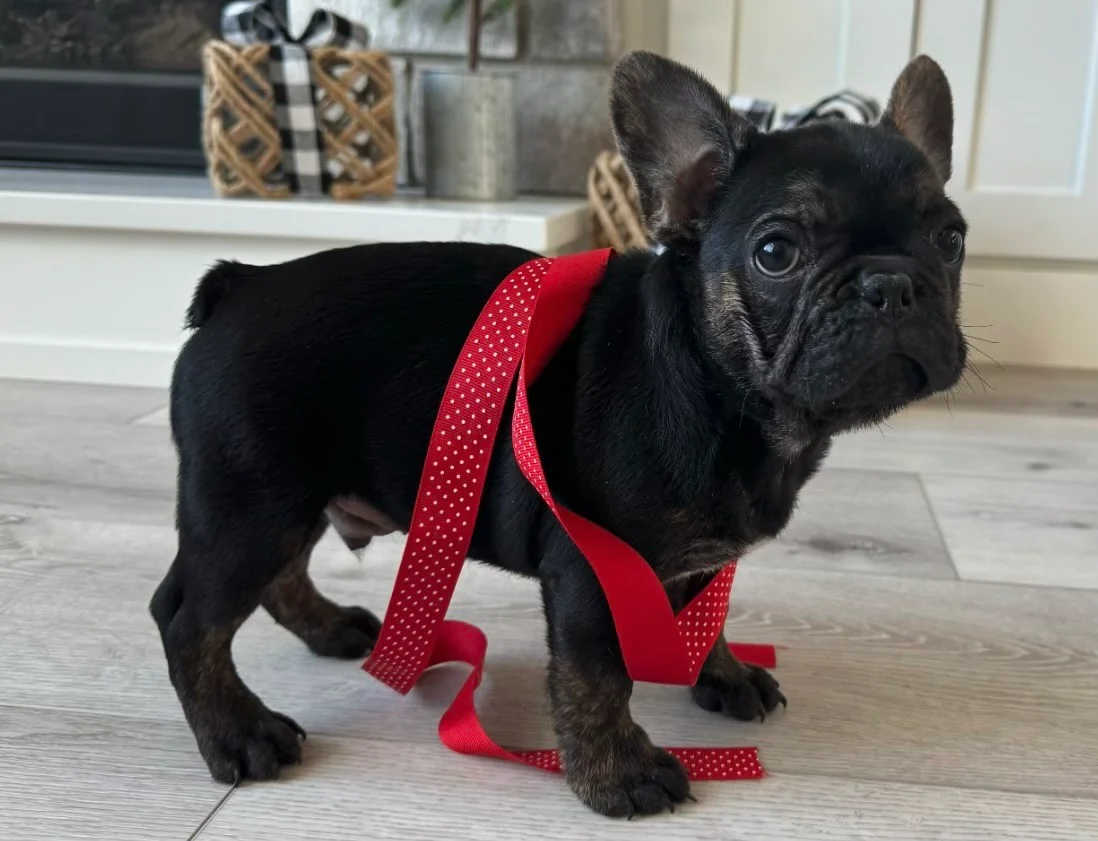
An average puppy will be 5 to 6 pounds when they are ready to go to their forever homes at 9 weeks of age, but some will be as little as 3 pounds and some as big as 7 pounds or more. Their weight at this time can be an indication of their weight as an adult, but we have been surprised on more than one occasion.
They open their eyes and start discovering the big world around them; actually, they don’t see much more than Mom, their littermates, and us, but that helps them greatly on their voyage to proper socialization.
Their ears open and they are able to hear, and another big part of their new world opens up. Prior to this event, about all they do is grunt or mew, but afterward their vocabulary includes yelps, whines, and even little barks.
At three weeks of age, the more advanced puppies start taking their first shaky steps; prior to this, their basic mode of transportation is basic army crawling. They are now able to urinate and defecate on their own and will move away from their sleeping area (under the heat lamp) to do so.
Their only nourishment is still mothers’ milk, although it is during this week that they start getting their little teeth. They are starting to get more active as they discover their new abilities to get around, although most of their time is still spent sleeping in their whelping box.
Up to this point it is strictly the mothers and us (Lacey and Bick) who have handled the pups (with lots of hand sanitizing before and after), and they have been kept in their whelping boxes with mom.
Even though it is hard on the kids, we do not let them or their friends handle the puppies until they are at least 4 weeks of age, when we move them from their whelping boxes to their kennels (half of which has a mesh floor and the other half has a solid floor on which they sleep and eat).
Initially, we put Mom in with her puppies at least three times per day, which will decrease to two times a day at 5 weeks and once a day starting at 6 weeks.
At four weeks we start introducing them to solid food, which is moistened with hot water. The mothers’ milk also decreases, and they naturally start wanting to decrease the length and frequency of nursing; those sharp little teeth probably play a big factor!
Most are walking like champs at this age and are even trotting/running. Most naturally learn to move on to the screened area of their kennel to do their business, although some are slower learners.
Eventually, they all get it, and this is the start of their house training, when they learn that there are certain places that they can "go" and other places that they can't. The kids are allowed to hold them now (closely monitored and with clean hands).
At 5 weeks of age they are getting very active during their awake times, during which they spend time tussling and roughhousing with their littermates in their kennels.
We generally let them out to play in our puppy play area at least once per day, and they love this time to run around and explore a bigger world. It is during this time when some of their adult personalities will start coming out.
By the end of this week their puppy teeth are all in, and they love to chew on things, including fingers if you let them. However, even at this age, they will spend most of their time sleeping, probably close to 20 hours per day, with only short intervals when they are alert and active between naps.
By the end of the 6th week, they are completely weaned from their moms and eating solid food well. We frequently take them out of their kennels to scamper around in the inside puppy play area or even in the outside puppy play area in nice weather.
They are full of energy and love to play with their littermates and the kids. This is the time that we really focus on socializing them. Even with all this energy, they sleep most of the time, probably still up to 20 hours per day.
By 7 weeks they have already passed through most of their puppy milestones and are generally in the 3- to 5-pound range. This is when their personalities really start coming out!
It is so fun to watch them play with the kids and their littermates and observe their new fascination with toys. They have become somewhat accustomed to going potty on pee pads, so when they are out running around the room, they often recognize them on the floor and will go potty on them.
Though they are fast, active, playful little puppies at this point in their lives, they still are like babies and require lots of sleep (generally over 18 hours per day) and are still quite fragile.
Starting at 6 to 7 weeks, we generally start FORMALLY reserving the Frenchie puppies from each litter. Before we do, we take each litter into our vet’s office to have each puppy thoroughly examined, and we post a video of each litter on our website.
We do videos instead of still shots so that clients have a better idea of each puppy's conformation, relative size, movements, and personality, in addition to its color.
At approximately 9 weeks of age, our puppies are generally ready to go to their forever homes, where their socialization and training will continue in earnest. Occasionally we keep puppies a little longer if we do not feel they are quite ready to go to their new homes.
Our clients are encouraged to come to our home to meet their fur babies, if this is feasible. We are also happy to meet our clients at either the Salt Lake City or the Provo airport with their puppies.
When this is not possible, we can arrange for one of our responsible puppy nannies to hand-deliver our puppies to meet their new owners at their nearest major airport. We also use surface nannies to deliver retirees and puppies to our clients' front doors in many areas of the country at very competitive rates.
All of our puppies follow a strict health protocol:
“THAT YOUR 9-WEEK-OR-OLDER PUPPY WILL STILL NEED A LOT OF SLEEP, GENERALLY AT LEAST 16 TO 18 HOURS PER DAY, IN A SERIES OF MEDIUM-LENGTH TO LONG NAPS.”
If they don’t get their proper amount of sleep, it can definitely have an impact on their overall health. Part of this sleeping time can certainly be accomplished when they are lying in your lap or next to you on the sofa, but don’t be alarmed when they sleep a lot, because that is what puppies are supposed to do.
In fact, even as adults they will sleep at least half of the day in a series of long naps, and probably closer to 14 hours per day.
If you ever have any sort of query, connect with Blue Haven French Bulldogs anytime! You can also check out our articles for more information and know more about us too!
Based on our years of experience raising these wonderful companions, here are the answers to the most common questions about the early weeks of a Frenchie’s life:
The first few weeks are a period of rapid growth and total dependence. Puppies are born blind and deaf, spending about 90% of their time sleeping.
During this stage, they cannot regulate their own body heat or even eliminate waste without physical stimulation from their mother (or a dedicated breeder).
By the end of the second week, their eyes and ears begin to open, and they start to transition from "army crawling" to discovering their surroundings.
You will typically see the more advanced puppies start taking their first shaky steps at three weeks of age. Before this, they mostly scoot or crawl. By four weeks, most are "walking like champs" and even beginning to trot or run around their environment.
We start introducing them to solid food at four weeks of age. We use high-quality food moistened with hot water to make it easy for them to chew and digest. This coincides with a natural decrease in the mother's milk production and the emergence of those sharp little puppy teeth.
BlueHaven French Bulldogs’ Frenchie puppies are generally ready to head to their forever homes at 9 weeks of age. This ensures they have been properly weaned and socialized and have received their necessary early vaccinations.
Occasionally, if a puppy is smaller or needs a bit more time to develop, we may keep them slightly longer to ensure they are 100% ready for the transition.
While you see glimpses of character early on, their adult personalities really start coming out around 5 to 7 weeks of age. This is when they begin to play with toys, tussle with their littermates, and show their unique fascination with the world around them.
By week 7, you can truly see which puppies are the "adventurers" and which ones are the "cuddlers.”
Bringing a French Bulldog into your life is a rewarding experience that begins with these critical first nine weeks of growth, care, and socialization.
From those first shaky steps to the emergence of their unique, clownish personalities, every milestone is a building block for a healthy and happy adult dog.
By understanding their needs, especially their requirement for plenty of rest and a structured health schedule, you are setting the stage for a lifetime of companionship.
Ready to find your new best friend and start your own journey?
Check out our available Frenchie puppies today!
The first thing is not to get overly worried (easy for me to say, right?) as this is a common condition for many Frenchie puppi...
Read More »
As with virtually all dog breeds, some Frenchie puppies will eat their poop, or that belonging to another pet, but fortunately ...
Read More »
Puppies from all dog breeds will occasionally throw up, as will adult dogs from time to time, but, from our experiences, it see...
Read More »