


If you have searched "what food is best for French Bulldogs," you have probably found a dozen conflicting answers. One site swears by home-cooked meals. Another insists only commercial kibble is safe.
Neither explains the actual nutrition science behind the choice. This guide breaks down what the research says about what food is best for French Bulldogs, so you can decide based on evidence, not opinion.
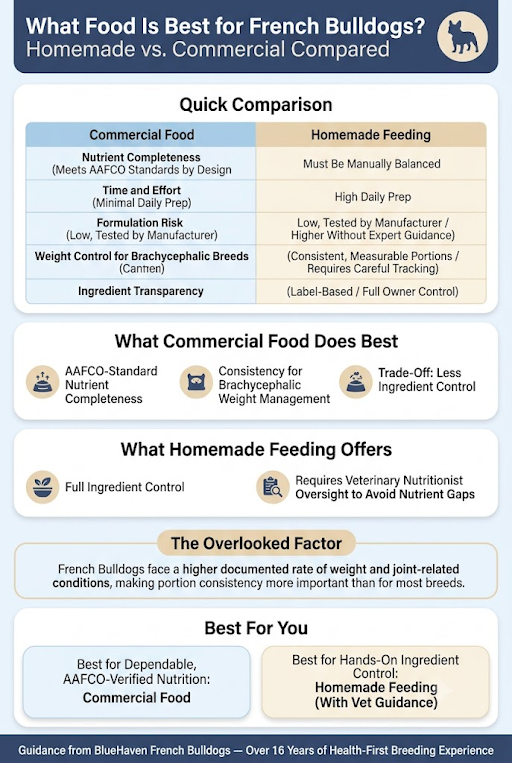
Quick Answer: Commercial food removes the guesswork around nutrient completeness, while homemade feeding demands more owner effort and veterinary oversight to stay balanced.
Quick Answer: Commercial food wins on nutrient certainty and consistency; homemade feeding wins on ingredient control if done correctly.
|
Criteria |
Commercial Food |
Homemade Feeding |
|
Nutrient completeness |
Meets AAFCO standards by design |
Must be manually balanced |
|
Time and effort |
Minimal daily prep |
High daily prep and planning |
|
Formulation risk |
Low, tested by manufacturer |
Higher without expert guidance |
|
Weight control for brachycephalic breeds |
Consistent, measurable portions |
Requires careful tracking |
|
Ingredient transparency |
Label-based |
Full owner control |
When owners ask what food is best for French Bulldogs, commercial food built to a recognized nutrient standard is usually the most dependable starting point. It works without needing a nutrition degree to get it right.
A dog food labeled complete and balanced must meet minimum and maximum nutrient thresholds set byAAFCO, covering protein, fat, vitamins, and minerals in every bag. That standard exists because getting these ratios wrong at home is easier than most owners expect.
The AAFCO nutrient profile is not a marketing claim. Manufacturers must document this formulation requirement before a label can say "complete and balanced."
For a new Frenchie owner, this means the guesswork is already solved before the bag is even opened. You are not left wondering whether a recipe covers your dog's calcium, zinc, or fatty acid needs.
Life-stage formulas add another layer of precision. A puppy formula and a senior formula are built to different nutrient targets, so matching the label to your Frenchie's age is part of getting this benefit.
French Bulldogs carry breed-specific health risks tied to their brachycephalic build, including a documented higher rate of weight-related and joint conditions compared to other breeds, according toVetCompass cohort research.
Commercial food with fixed nutrient density and clear feeding guidelines makes portion control far more predictable than adjusting a homemade recipe by eye. That predictability matters more for a Frenchie than for a breed without the same joint and airway sensitivities.
Commercial food is not without limitations. Owners have less say over specific ingredient sourcing. Some dogs need formula changes to manage sensitivities or allergies over time.
This is a real trade-off, not a reason to dismiss the format. For most Frenchie owners, reading the ingredient list and confirming the AAFCO life-stage statement covers the majority of concerns about commercial diets.
A quick label check takes less time than researching a single homemade recipe. That single habit closes most of the gap owners worry about when they compare the two feeding methods.
Homemade feeding appeals to owners who want full ingredient control and a hands-on role in their dog's diet. Many are uneasy about recalls or filler ingredients.
Research on home-prepared diets shows owners are often motivated by concerns about commercial food quality and a desire for fresher ingredients, according to aFrontiers review.
Done well, with a veterinary nutritionist checking the recipe, homemade feeding can meet a Frenchie's needs. Done without that oversight, it carries real risk: analysis of home-prepared diets found shortfalls in calcium and other minerals across many recipes reviewed, according to research published inPMC.
Quick Answer: The real cost of homemade feeding is not the grocery bill. The bigger risk is an unbalanced diet going unnoticed for months.
Yes, homemade feeding gives owners full ingredient control. That control only pays off if every meal hits the right nutrient targets.
Analysis of home-prepared diet recipes found inconsistent mineral levels across the board, per thePMC nutrient analysis. A well-intentioned recipe can still fall short without lab-level verification.
Most general dog-food comparisons never mention brachycephalic-specific needs at all. French Bulldogs face a higher documented rate of weight and joint-related conditions than many other breeds, based onVetCompass cohort data.
This makes consistent, measurable nutrition more important here than for a typical medium-sized dog. Portion consistency tied to your Frenchie's ideal weight matters more than the feeding method itself.
Quick Answer: BlueHaven French Bulldogs applies the same health-first standard to feeding guidance that it applies to its breeding program.
BlueHaven French Bulldogs has spent over 16 years breeding with a health-first approach, avoiding pairings linked to significant health issues. That same standard shapes how the multi-generational family team, led by Bick and Lacey, talks new owners through feeding decisions once a puppy comes home.
One BlueHaven family shared this update after bringing home their puppy:
"She had her 3rd series of shots and vet check last week and is perfectly healthy. She's growing wonderfully, weighing 10.1 lbs, which is double her weight from when she got here."
This kind of steady, tracked growth is exactly what a sound feeding plan should produce. That holds true regardless of which method an owner ultimately chooses.
Best for dependable, AAFCO-verified nutrition without daily formulation risk: owners who want a reliable, tested baseline should lean toward commercial food.
Best for hands-on ingredient control: owners willing to work with a veterinary nutritionist on a fully balanced, verified recipe can succeed with homemade feeding.
1. Is homemade food better for French Bulldogs than commercial food?
Neither option is automatically better. Commercial food removes nutrient-balancing risk, while homemade feeding can work well only when a veterinary nutritionist verifies the recipe against your Frenchie's specific needs.
2. What nutrients are hardest to balance in a homemade French Bulldog diet?
Calcium and other minerals are commonly under-supplied in home-prepared dog diets, according to nutrient analysis research. This is one reason unsupervised homemade diets carry a documented formulation risk.
3. Can French Bulldogs eat a mostly commercial diet with homemade toppers?
Many owners combine a complete commercial diet with small, vet-approved fresh toppers. This keeps the nutrient foundation intact while still allowing some homemade variety.
4. How do I know if my French Bulldog's food is nutritionally complete?
Check the label for an AAFCO complete and balanced statement matched to your dog's life stage. If you are feeding homemade, ask a veterinary nutritionist to review the recipe against those same standards.
The honest answer to what food is best for French Bulldogs depends on how much formulation risk you want to manage yourself. Talk to a veterinary nutritionist before switching your Frenchie to a homemade diet.
Check any commercial bag for the AAFCO complete and balanced statement before you buy. Reach out to BlueHaven French Bulldogs for feeding guidance rooted in over 16 years of health-first breeding experience before your puppy comes home.
_1790025093.png)
Why Are French Bulldogs So Expensive and What It Means for Prospective Owners
Read More »
What Are French Bulldog Tail Types, and Why Do They Matter for Prospective Owners French Bulldogs are born with naturally short...
Read More »
What Is Involved in Buying an Adult French Bulldog and Why It Matters for Frenchie Families Buying an adult French Bulldog give...
Read More »