

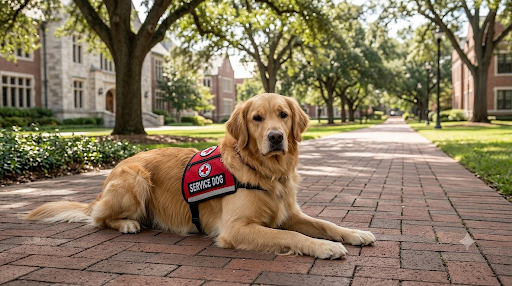
A psychiatric service dog letter must be signed by a mental health professional who holds an active license in your state. Most requests fail because the patient asks for the wrong document or approaches a provider who cannot issue one. Under the federal Fair Housing Act, only a letter from a state-licensed mental health professional obliges a landlord to accommodate the dog. Handlers who prepare for the appointment properly leave with documentation that survives landlord scrutiny.
A psychiatric service dog letter must come from a licensed mental health professional who holds an active license in the state where you live. General medical training is not the qualifying factor. State licensure is.
The following credentials qualify:
Title varies by state. Pennsylvania and Texas license counselors as LPCs, while New York uses LMHC for the equivalent role. A landlord evaluating your psychiatric service dog letter checks the license, not the job title.
Interstate compacts allow some clinicians to practice across state lines. PSYPACT covers psychologists in more than 40 participating states. The Counseling Compact, the Social Work Compact, and the LMFT Compact extend similar authority to counselors, clinical social workers, and family therapists.
RealESALetter.com publishes the name, credential title, and state license number of every therapist on its panel.
Bring a clear account of how your condition limits your daily activities and a description of the tasks your dog performs. Providers issue letters based on clinical evidence, so the quality of what you bring shapes the outcome.
Describe function rather than requesting a label. Explain which activities your condition interferes with, how often, and for how long. Approximately 1 in 5 Americans live with a qualifying mental health condition, and the qualifying test turns on functional limitation rather than diagnosis alone.
Name the specific tasks your dog performs. Interrupting a panic cycle, waking you from a night terror, and applying pressure during acute distress are all trained tasks. Comfort provided through presence alone is not.
State the housing situation prompting the request. A provider writing for a landlord accommodation needs to know that is the purpose.
Answer honestly. A licensed provider will decline to issue a letter when one is not clinically appropriate, and that judgment protects every letter the provider does sign.
Your provider confirms your qualifying condition and your disability-related need for a task-trained dog. You remain responsible for the training itself.
This distinction matters more than most guidance admits. A clinician has no way to verify tasks they did not train and did not observe. A letter claiming to certify your dog's training asserts something outside the provider's professional competence, and a landlord's counsel can attack it on exactly that basis.
The defensible structure separates the two roles. The provider attests to the clinical need. You attest to the training.
A valid psychiatric service dog letter contains the provider's credentials, confirmation of your qualifying condition, and confirmation that a task-trained dog forms part of your treatment. Missing elements are the most common reason landlords reject documentation.
Every letter must include:
The date carries weight. Letters remain valid for 12 months from the date of issue, and most landlords require documentation issued within the past year. You can verify a provider's standing before your appointment by reviewing licensed clinicians and their state license numbers.
RealESALetter.com letters are issued by state-licensed therapists and include all credentials landlords are required to recognise under the Fair Housing Act.
Task training now determines how strongly federal enforcement backs your housing request. That was not true before May 22, 2026.
HUD set out its previous position in guidance on assistance animals issued on January 28, 2020. That guidance told housing providers how to evaluate a request for an assistance animal and confirmed they could ask for documentation of a disability-related need from a health care professional. It did not require an emotional support animal to be individually trained. Under that framework, a qualifying condition and a documented need were enough to open a federal complaint, and training was not the dividing line.
On May 22, 2026, HUD announced it will no longer pursue housing complaints where the animal is not individually trained to perform disability-related tasks. Training became the dividing line at the federal enforcement level on that date. The 2020 documentation standard still describes what a landlord may ask you for, but it no longer describes which complaints HUD will take up.
What did not change matters as much as what did. The Fair Housing Act statute has not changed. Landlords carry the same legal obligation they carried before the announcement. State enforcement remains fully active.
A dog trained to perform specific disability-related tasks therefore sits on the stronger side of the line HUD drew in May 2026. That places a genuine clinical evaluation from a state-licensed therapist at the center of your documentation, more so than at any point previously.
File a complaint directly with your state civil rights or human rights agency, which remains fully active in enforcing housing law. State enforcement did not narrow in May 2026, and the guidance issued that month reached only HUD's own complaint handling.
Submit your letter, your written accommodation request, and the landlord's response. Keep every message in writing.
You can also file with HUD at hud.gov or call 1-800-669-9777. Treat that as a secondary route rather than your first step.
No registry, certificate, or ID card replaces a letter signed by a licensed mental health professional. Landlords are obliged to recognise clinical credentials, not purchased merchandise.
The dog does not need to be registered anywhere. Databases, vests, and printed certificates carry no legal weight under the Fair Housing Act, and a landlord who accepts one is doing you a favor rather than following a legal requirement.
Services like RealESALetter.com connect renters with state-licensed therapists who conduct genuine clinical evaluations before issuing letters.
Q1. Can my primary care doctor write a psychiatric service dog letter?
A primary care physician can write a psychiatric service dog letter if they hold an active license in your state and have evaluated your condition. Mental health specialists carry more weight with landlords because the qualifying condition falls within their scope. Ask your physician whether they are comfortable attesting to a psychiatric condition.
Q2. Can a nurse practitioner write a psychiatric service dog letter?
A nurse practitioner with a psychiatric specialty can write a psychiatric service dog letter. The practitioner must hold an active license in your state. General nurse practitioners without a psychiatric specialty fall outside the qualifying credential list.
Q3. Did HUD change the rules for emotional support animals in 2026?
HUD changed its enforcement approach in May 2026 without changing the Fair Housing Act itself. The agency now declines to pursue housing complaints where the animal is not individually trained to perform disability-related tasks. HUD's earlier guidance from January 2020 treated training as irrelevant to whether a complaint was reviewed. Landlord obligations under the statute are unchanged, and state enforcement agencies remain fully active.
Q4. Does my provider need to describe my dog's trained tasks?
Your provider confirms your qualifying condition and your need for a task-trained dog rather than certifying the training itself. You supply the description of what your dog does. The provider confirms that a task-trained dog forms part of your treatment.
Q5. How long does a psychiatric service dog letter stay valid?
A letter is valid for 12 months from the date of issue. Most landlords require documentation issued within the past year. Renewal requires a fresh evaluation rather than a reissued copy of the original.
Q6. Can my provider refuse to write the letter?
A licensed provider can decline to issue a letter when it is not clinically appropriate. Clinical judgment governs the decision. A provider who issues letters without evaluation produces documentation that landlords can challenge.
Q7. Does registering my dog replace the letter?
No registry replaces a letter signed by a licensed mental health professional. Registration databases and ID cards hold no standing under the Fair Housing Act. The signed letter is the only document a landlord is obliged to consider.
Book with a mental health professional licensed in your state, and confirm their license number before the appointment rather than after. Arrive with a written account of how your condition limits your daily activities and a list of the specific tasks your dog performs. Check that the letter you receive carries the provider's credentials, license number, practice letterhead, signature, and date of issue. If a landlord refuses valid documentation, your state civil rights or human rights agency is the enforcement route, and it remains fully active.
_1792608408.jpg)
Best Washable Pee Pads for Dogs: Reusable, Highly Absorbent Picks for 2026 Bringing home a new French Bulldog puppy means plent...
Read More »_1792604232.png)
What Are the Signs of a French Bulldog Tail Pocket Infection, and Why Does It Matter for Puppy Buyers If you are buying a Frenc...
Read More »_1792603645.png)
Adult vs. Puppy French Bulldog: Which Is Right for You? Trying to decide between adult vs. puppy French Bulldogs: which is righ...
Read More »